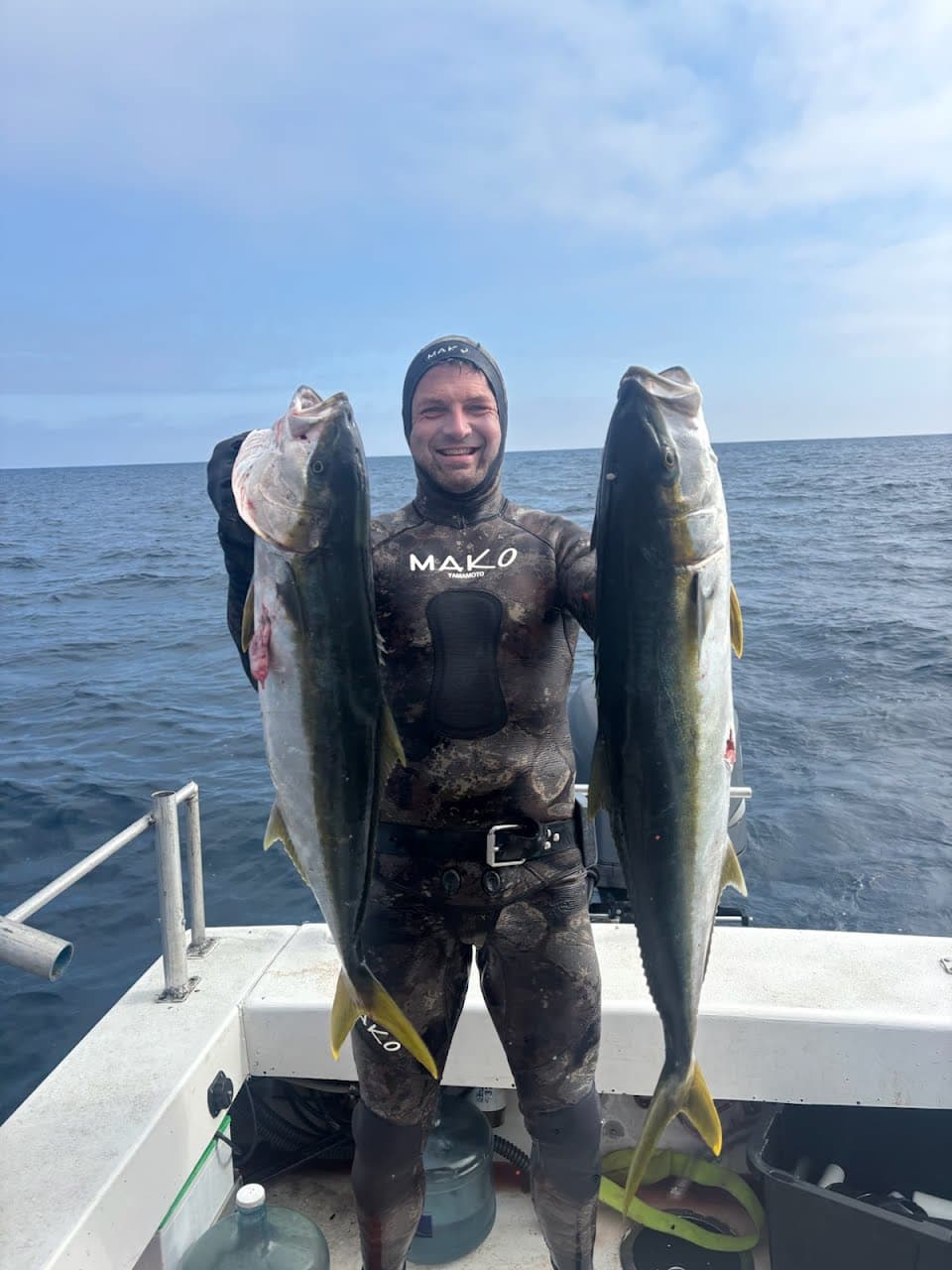
Somewhere off the front side of Catalina, on the outside edge of the kelp where the reef falls away into deep water, there is a yellowtail the local divers would call a homeguard. My understanding of the homeguard story goes like this: he was born hundreds of miles south, in Mexican water. He came north across the border with the warm water, in a school of fish that looked exactly like him. Then one season, at about thirty inches, he quit traveling. He settled into that reef system, learned it, and has been there since.
Forty miles offshore, under a paddy the size of a kitchen table, five hundred of his younger relatives are doing what he used to do, which is eat and cover water like something is chasing them.
These two stories made me wonder if they are backed by science.
For half a century, the closest thing anyone had to an explanation came from one man. In the 1950s, a California Department of Fish and Game biologist named John Baxter put conventional tags on yellowtail, mostly off central Baja, and published what he found in 1960 as Fish Bulletin 110. It's a great piece of work, and modern researchers still lean on his growth curves. But for the next fifty years, what anyone could tell you about yellowtail movement was mostly Baxter's data or dock talk built on top of it. The typical story is that the fish winter down off Cedros and Benitos, ride the warm water up the line in late spring, spread through the islands and the paddies all summer, then slide back south when the water cools. That is the whole model.
Then, starting in the late 2000s, a handful of researchers at Scripps and NOAA went back at the question with tools Baxter never had: acoustic tags, stable isotope chemistry, otolith aging, mercury tracers. What they found mostly confirms the old story and adds to it.
The fish you meet twice
If you've fished yellowtail for more than a few seasons, you already know these two animals, even if nobody handed you the science.
There's the paddy fish. He's ten to twenty pounds, he runs in a school, he crashes bait under a floating kelp mat, he's dumb-hungry, and he moves fast. And then there's the big, dark fish that is usually alone or in a small group, the one the old-timers call a homeguard or a mossback.
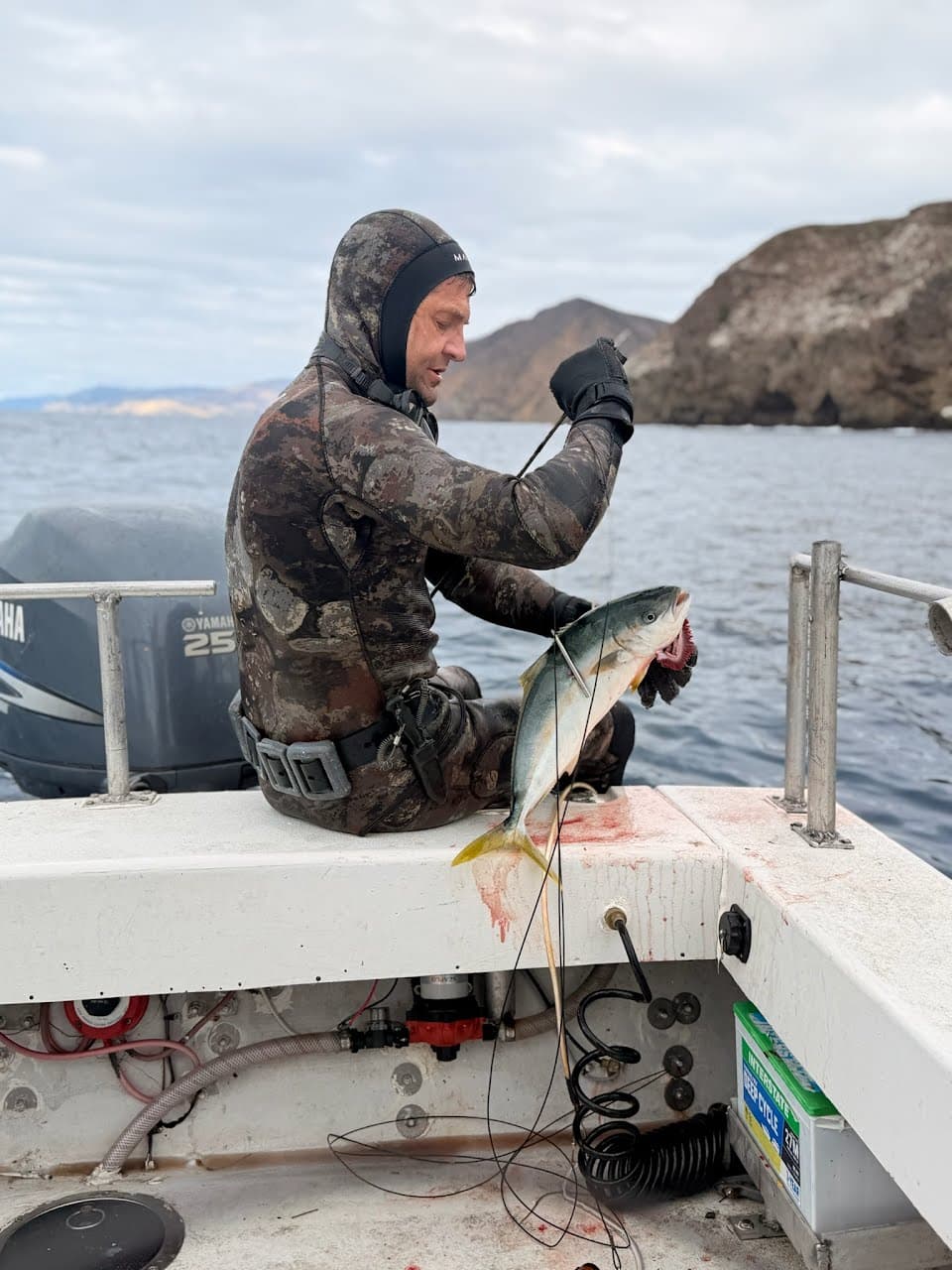
They're the same species and they tend to show up in different ways.
What always bothered me was that the fish show up at the same time of year. So I wondered, does the science back up that these fish live differently?
What the chemistry says
In 2018, Daniel Madigan and colleagues published “From migrants to mossbacks.” They ran stable isotope analysis on yellowtail muscle tissue. What a fish eats, and where it eats it, leaves a chemical signature in the flesh that stays there for months.
Small yellowtail, under about 30 inches, carried the isotopic signature of the open ocean. Chemically, they were nearly indistinguishable from yellowfin tuna. Big yellowtail, over about 35 inches, looked like white seabass, a coastal fish that lives in the kelp. And in between, across a narrow window of roughly 76 to 88 centimeters of fork length, the signature flips.
The conventional tagging backed it up, though the numbers were small: 48 fish tagged, 15 recaptured. Fish tagged offshore under paddies covered ground at rates around a mile a day and sometimes far more. Fish tagged inshore on the kelp barely moved, and all six of the inshore fish that were recaptured came back inshore. Three of the nine recaptured offshore fish were later recaptured inshore. None were caught going the other way.
A yellowtail in its migrant years rides warm water, hunts the open ocean, shelters under drifting kelp, and can end up hundreds of miles from where it started. Conventional-tag returns, from Baxter's era through the modern program, show intermediate-size fish recaptured hundreds of miles from where they were released, while the smallest and largest fish, however much water they covered day to day, were recovered within tens. Then, somewhere around four to six years old by the old growth curves, and 30-some inches long, the fish starts feeding like it lives onshore. Maybe it settles into a reef system and mostly stays inside it. Big fish do turn up offshore sometimes, and when they do, their flesh still reads coastal, which the researchers take to mean short trips, possibly to spawn, and not a return to migrating. When the Scripps team aged these fish by their ear bones, counting rings the way you'd count them on a stump, the oldest came back 22 years old.
Waking up, or arriving?
If the big fish are residents, living in the same reef system all year, the coast in February should be full of them. That is not what I see. I almost never see a big yellowtail unless the small ones are around, and in cold water I don't see them at all. The counts climb when the warm water comes and crash when it leaves, and yet the name homeguard implies a fish that never leaves.
I should say what I mean by resident. Nobody I dive with actually thinks a yellowtail lives on one rock. What they mean is a reef system, some stretch of rocks and kelp edges where a big fish shows up at certain spots more than others, and usually alone or with one or two others, not in a school. A few inshore divers have told me they take big fish off the same reef system all year, February included. If those fish are all over the size where the switch happens, that is real evidence for residents that stay put and stay visible, at least where those guys dive. Most of my diving is out at the northern islands, and out there the big fish don't get seen when the small fish leave.
The isotope studies sampled fish caught the way everyone catches them, hook and line, mostly in season, so nobody was pulling muscle plugs off homeguards in February. But muscle chemistry changes slowly. The carbon signature takes most of a year to turn over, so when a big fish caught in June carries a signature that reads far more coastal than pelagic, the simplest explanation is that he was eating off the coastal food web through the winter. Without a satellite tag, nobody knows where those fish actually are in January, and the chemistry can't put him on any particular spot in March or say anything about whether you could see him.
Cold water turns a fish's metabolism down. Divers who work structure in the winter tell me the big fish go deeper in the cold months and sit on the squid beds, and they don't move much until the water warms up and the bait comes back in. A fish doing that in green March water may as well not exist to a diver, and he never left his reef system. That's one story. But there's a second one that fits the same evidence, and I can't rule it out: the big fish know where every reef system on this coast is, and they follow the warm water up and down it, coming back to the ones they've used before. The chemistry can't separate those two stories, because a fish running the coast eats coastal the whole way. The tag returns lean toward the stay-put version, since recaptured big fish were recovered within tens of miles, but almost every recapture happens in season, which is exactly when a traveler would be back on his spot. The acoustic tags say the same thing. In the La Jolla array the bigger fish kept getting picked up by the receivers no matter what time of year they were tagged, and the study takes that as evidence for year-round residents inshore. But a fish running a circuit through a few fixed spots gets picked up exactly the same way as a fish that never leaves. And on the only coast where anyone has satellite-tracked adults of this fish's closest cousins, Australia, the big ones roam thousands of kilometers. So either the fish stays in one reef system and goes deep and slow for the winter, or he works the whole coast and moves between reef systems. I can't tell those two apart with anything we have. Maybe there is another hypothesis I'm missing, but satellite tagging would solve this.
What they're eating, and why it matters for finding them
The stomach-content work from 2014 through 2016 sampled fish from San Diego down through Baja and found what you'd expect plus one surprise. Sardines, anchovies, and Pacific and jack mackerel made up over 60 percent of identified prey; market squid made the list too. The single most common item, though, was pelagic red crab, showing up in nearly a quarter of all stomachs. That was a warm-water artifact. Those years were the Blob and a big El Niño stacked on top of each other, and red crabs got pushed north into everything. Yellowtail are opportunists, and they eat whatever the warm water brings in.
Bigger fish eat a wider range of prey. Small fish eat a short list of pelagic baits. Big residents eat all of that plus rockfish, blacksmith, señoritas, halfmoon, and whatever else is on the reef. By the study's own math, large yellowtail feed an estimated one to two trophic levels above the smallest of their own kind, so the mossback is sitting at the top of the food chain on his reef.
Mercury concentrations in yellowtail step up sharply right at the size where fish go resident, around 88 centimeters. Bigger, older, inshore fish carry meaningfully more mercury than the pelagic grades, and a few of the sampled fish were approaching or exceeding the FDA's action level. It's something to weigh when you're deciding whether that trophy goes on the wall, in the freezer, or back over the rail.
Reading the water for each fish
For the migrants, temperature is the whole ballgame. These fish are following a thermal comfort zone north. The catch records going back to the 1950s show it plainly: warm years produce big yellowtail seasons, cold years mostly don't, and biologists were documenting that correlation as early as 1961. The aquaculture side pins the numbers down tighter than any wild study has. Captive yellowtail spawn when the water is between 16 and 22 degrees Celsius, roughly 61 to 72 Fahrenheit. The broader habitat envelope you'll see cited for the species, from occurrence records rather than the hatchery, runs about 18 to 24 degrees, call it 64 to 75.
But temperature only tells you where the water is comfortable. It doesn't tell you whether there is anything to eat, and that is what the chlorophyll layer is for. Chlorophyll concentration maps the plankton, and the plankton maps the bait. The green water is where the food is. The blue water mostly isn't, but you can see in it, and the hook-and-line guys fish the line between the two.
Spearfishing is different. I can't shoot a fish I can't see, and I don't see yellows in green water, so I'm hunting the blue side of any line. What I want is clear, blue, warm water, and ideally water that just got here. A fresh push of clean blue water carries fresh fish, new bodies moving through that haven't been worked over yet. Water that's been parked for a week has been picked over. So the way I actually use the color chart is to find the blue water and watch it move. The green-to-blue line matters to me as the boundary of the good water, because flipping through the recent passes tells me whether the push is building or dying and where it's headed. I want to be at the front edge of the blue water as it comes in. No study proves any of this. I went looking for a published habitat model for this fish and came up empty. The warm-year part of the story has seventy years of catch records behind it, and the rest is my own experience in the water.
The Baja question
The modern work mostly settled one more question. Genetics and conventional-tag returns both point to yellowtail from Point Conception down through Baja being a single connected population. The differences you see between regions look like differences in age structure, though fair warning: the genetic sampling behind that conclusion is fourteen fish, total, and none of them came from Guadalupe. In the modern sampling, the fish off Cedros and Guadalupe ran bigger and older than anything from the Bight, and the plain-language explanation is that those islands are far from the fleet. They likely function as accidental refuges where fish get the chance to become 20-year-olds, and a ninety-pound fish is just a yellowtail that got left alone that long.
In CalCOFI plankton tows from 1954 through 1969, yellowtail larvae turned up in 206 samples. Ninety-six percent of those occurrences were off Baja California, and 83 percent were in July and August. That means the schools of grade fish that light up a SoCal summer are, to a large degree, exported from the south. The state said as much back in 1973, calling the California sport catch almost entirely dependent on migrants from central and northern Baja. Most of the fish you catch in July were spawned off Baja.
What we still don't know, which is a lot
I went looking for a stock assessment for California yellowtail. CDFW's own 2022 status review says no assessment and no abundance estimate for the species. All the tagging so far has been conventional tags you hope get returned and acoustic pingers that only speak when a fish swims past a receiver. I looked for a satellite tag on a wild one, and for a model of which ocean conditions predict where they'll be. I found neither. What a homeguard actually does between December and March is one more thing I went looking for and couldn't find. The published temperature numbers come from catch records, occurrence data, and hatchery tanks, not from tracked fish.
The fecundity math is worth knowing too. The old CDFG egg counts, Baxter's 1960 work and the follow-up that built on it, put a three-year-old, 10-pound female at around 450,000 eggs from her single spawn of the season, and a seven-year-old, 20-pound female, spawning several times, near a million. A big old female out-produces a young one many times over, and she's the slowest fish in the water to replace. What that means for a population fished on both sides of the border is exactly the kind of question a stock assessment would answer. The closest thing I found is a 2024 catch-only model of the Mexican landings, which concluded the stock is being overfished, with all the caveats that kind of model carries.
Both fish, the migrant and the resident, can be found with the temperature and chlorophyll charts. If you fish Southern California yourself, our sea surface temperature map is built for exactly this kind of read.
Sources for the curious: Baxter (1960), CDFG Fish Bulletin 110; Madigan, Snodgrass & Fisher (2018), “From migrants to mossbacks,” Marine Ecology Progress Series 597; Ben-Aderet et al. (2020), Fishery Bulletin 118(2); Ben-Aderet (2017), UC San Diego doctoral dissertation; Stuart & Drawbridge (2013), Aquaculture Research; Sumida, Moser & Ahlstrom (1985), CalCOFI Reports 26; Martinez-Takeshita et al. (2015), Copeia 103(2); Collins (1973), CDFG Marine Resources Technical Report 16; García-Rodríguez et al. (2024), Marine Policy 168. All are worth reading and most are free online.