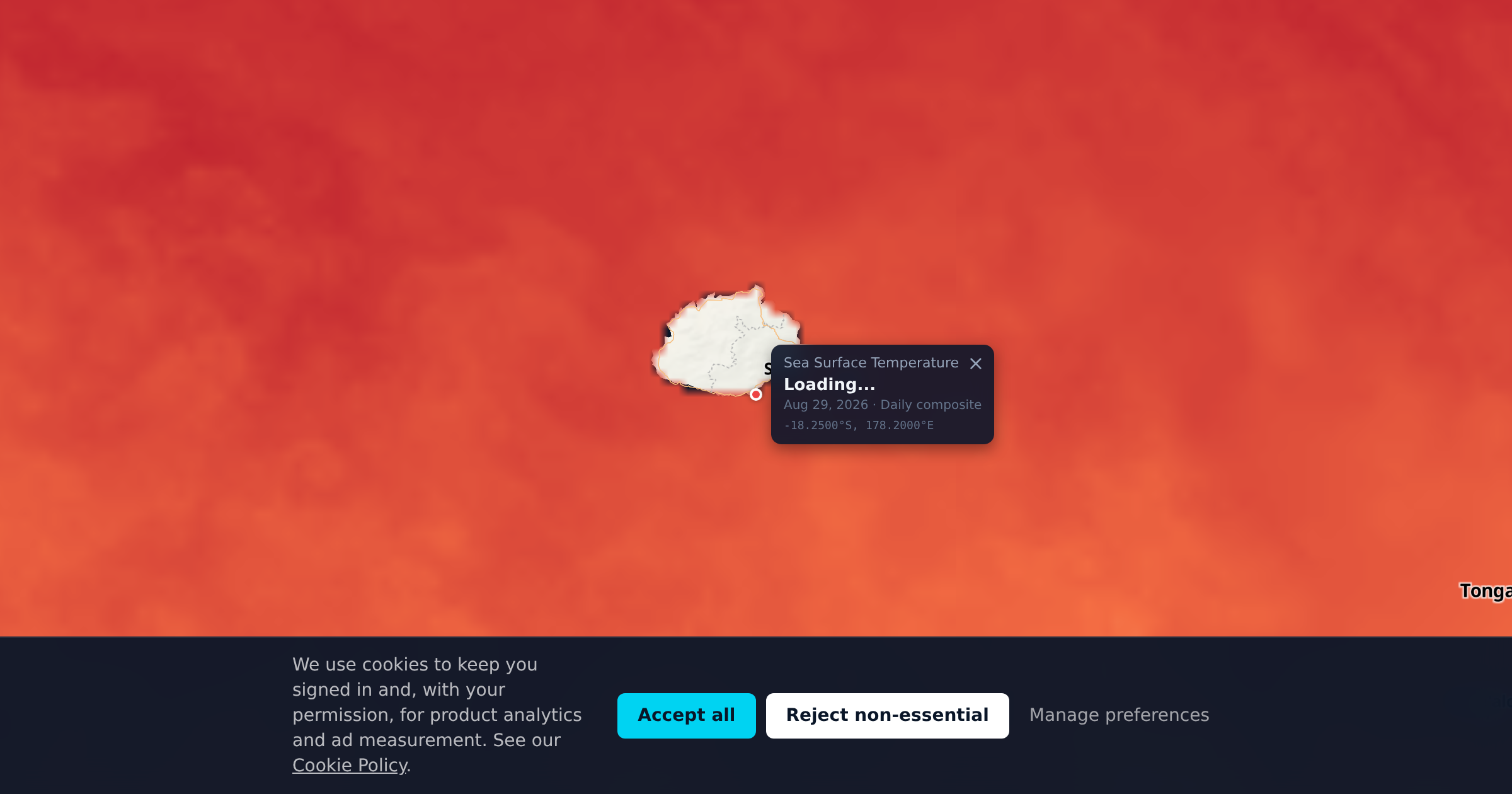
Fiji sits on a shallow platform surrounded by water that falls away to more than a mile deep, and the drop happens fast. Off Kadavu the bottom goes from reef to blue water in under two miles. That geometry, plus the South Equatorial Current pushing warm water across the archipelago from the east, is why a small island group produces blue marlin, dogtooth tuna, and giant trevally within sight of the reef.
The Bligh Water between Viti Levu and Vanua Levu is the heart of it. Current funnels through the Vatu-i-Ra passage, piles against seamounts and reef edges, and concentrates bait in a way that open ocean at this latitude never does. Water runs 79-84°F year round, so the seasons here are about wind and current, not about temperature collapse.
Species and Seasons
Blue marlin: October through April, peaking December through March when the water is warmest and the trades ease. Fished along the outer reef drop-offs and over the seamounts north of Viti Levu. Fish of 300-500 lbs are the working average, with genuine granders hooked most seasons.
Yellowfin tuna: Year-round with a strong push June through September. Found on current lines and around the offshore banks, often under bird schools working with spinner dolphin. Fish run 20-80 lbs inshore and well over 100 lbs on the deeper banks.
Wahoo: May through September, the cooler trade-wind months. Held tight to reef passes and drop-off edges where current accelerates. The Kadavu passages and the northern side of Vanua Levu are consistent. Fast trolling along the 40-fathom line is the standard approach.
Dogtooth tuna: Year-round on the deeper pinnacles and reef corners, best when the current is running hard. A jigging and popping target rather than a trolling one, and the reason a lot of anglers come here specifically. Fish over 100 lbs are caught off the outer reefs.
Giant trevally: Year-round, most aggressive October through April. Reef edges, passes, and the shallow flats around the Yasawas and Mamanucas. Popping and stickbaiting over shallow coral is the method. Fish of 60-80 lbs are realistic on the outer reefs.
Mahi mahi: December through April, associated with floating debris and current edges after wet-season runoff pushes structure offshore. Often found alongside the marlin grounds.
Sailfish: November through March, more common in the shallower water inside the Koro Sea than out on the marlin grounds.
Spanish mackerel: June through October along reef edges and around the Mamanuca passes. A reliable light-tackle and spearfishing target when the trades are steady.
Diving Beqa Lagoon and the Somosomo Strait
Beqa Lagoon south of Viti Levu is the best known shark diving in the Pacific. Eight species use the site, including bull sharks and tiger sharks, in a channel where current delivers food predictably. The surrounding lagoon has soft coral bommies in 40-80 feet with excellent visibility outside the wet season.
The Somosomo Strait between Vanua Levu and Taveuni holds the Rainbow Reef and the Great White Wall. Current running through the strait feeds dense soft coral growth that colours the wall in white and lavender at depth. Best dived on a running tide, which is also when visibility peaks.
The Great Astrolabe Reef off Kadavu is one of the largest barrier reefs in the world. Steep outer walls, manta cleaning stations at the northern end, and reliable pelagic traffic along the drop-off.
Visibility runs 60-100 feet through the dry season and drops after heavy wet-season rain, particularly near the larger river mouths on Viti Levu.
Why SST and Chlorophyll Matter Here
Fiji sits in warm, low-nutrient tropical water. Surface temperature rarely leaves the 79-84°F band, so absolute temperature tells you little. What matters is structure: where warmer South Equatorial Current water meets slightly cooler water lifted by the reef and seamount topography. Those boundaries are narrow, often only 1-2°F, and they are where the bait sits.
The seamounts and reef passes force upwelling when current runs across them. That upwelling is what turns a patch of open ocean into a marlin ground, and it shows on chlorophyll imagery as a small elevated patch against a very clean background. In water this clear, a rise from 0.05 to 0.15 mg/m3 is a real productivity event, not noise.
Wet-season runoff from Viti Levu and Vanua Levu pushes a nutrient plume offshore between December and April. The outer edge of that plume, where green river water meets blue ocean, is a productive and easily readable line on chlorophyll imagery.
Fishing & Diving Calendar
December-March: Wet season. Blue marlin peak. Mahi mahi and sailfish. Giant trevally aggressive on the reefs. Runoff plumes offshore. Variable visibility inshore. Water 82-84°F.
April-June: Transition. Late marlin. Wahoo building. Trades steadying. Visibility improving. Water 81-83°F.
July-September: Dry season and peak trades. Wahoo and yellowfin best. Dogtooth on the pinnacles. Spanish mackerel on reef edges. Best visibility of the year. Water 79-81°F.
October-November: Trades easing. Blue marlin arriving. Giant trevally strong. Water warming. Water 80-82°F.
Fishing nearby waters too? NZ North Island and East AU - QLD are the closest covered regions. See pricing for what a plan covering Fiji costs.