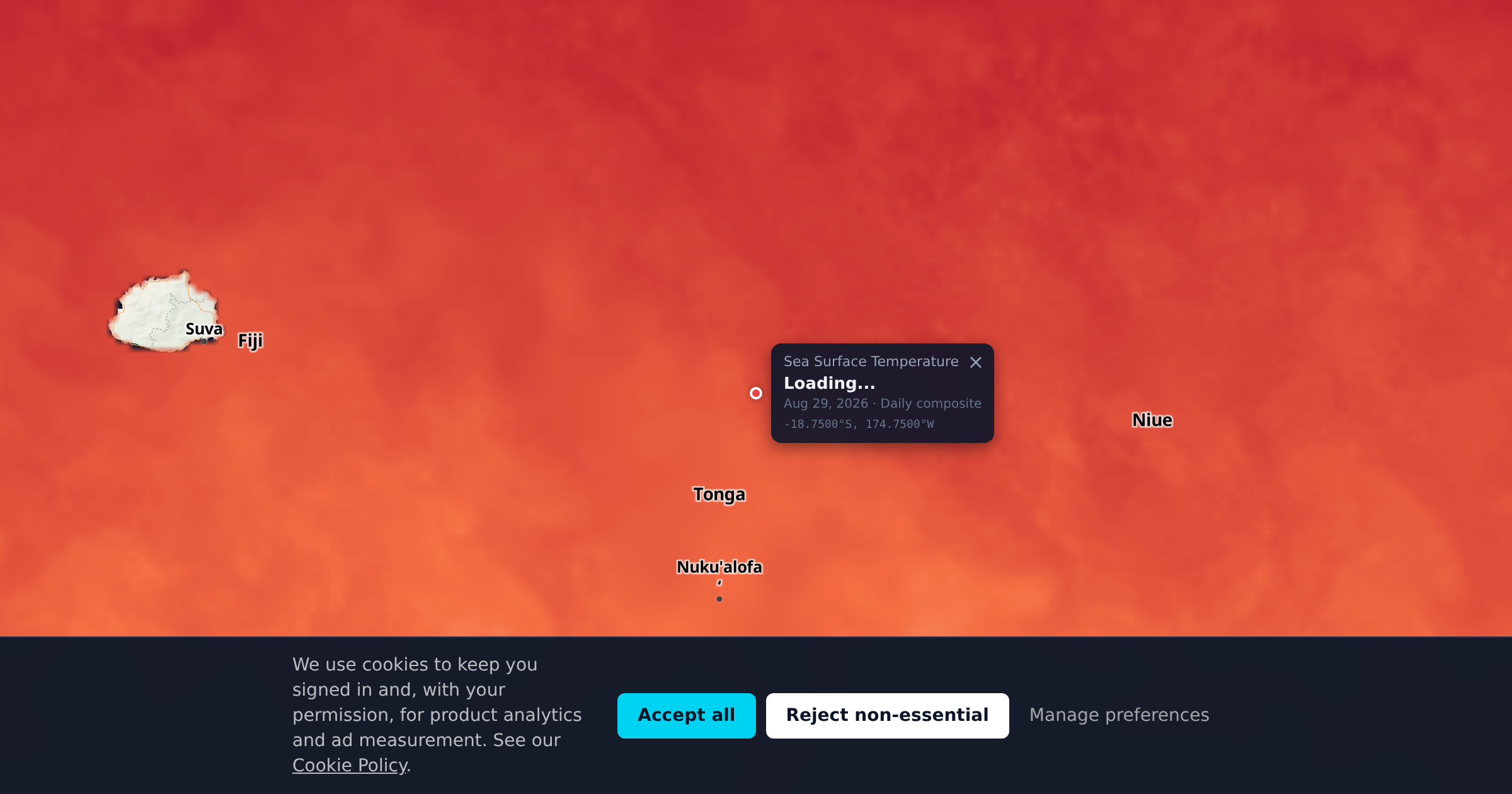
The Tonga Trench runs the length of this region and bottoms out below 35,000 feet, the second deepest water on the planet. It sits close enough to the islands that boats out of Vava'u cross from 100 feet to 3,000 feet in a short run. Deep water that close to shallow reef is the whole story of fishing here, and it is why Vava'u has a blue marlin reputation out of all proportion to its size.
The islands run north to south across roughly 500 miles: Tongatapu in the south, the shallow Ha'apai bank in the middle, and Vava'u in the north with its sheltered island maze. The South Equatorial Current sets across all three, piling water against the trench wall and the seamounts that rise off it.
Species and Seasons
Blue marlin: The headline fishery. October through April, peaking December through March. Fished along the trench edge and over the seamounts north and west of Vava'u. The drop-off is close enough that boats are on the grounds inside an hour. Fish of 400-600 lbs are common and larger ones are hooked most seasons.
Yellowfin tuna: Year-round, best May through October. Found on current lines over the trench wall and around the offshore banks, often mixed with skipjack under working bird schools. Fish run 30-100 lbs with larger ones on the deeper structure.
Wahoo: May through October during the cooler trade months. Held on the reef drop-offs and the outer edge of the Ha'apai bank where current accelerates over shallow ground. Consistent on fast-trolled lures along the 30-fathom contour.
Dogtooth tuna: Year-round on the deep pinnacles off Vava'u and the seamounts west of Ha'apai. Best on hard current. Jigging over structure in 150-300 feet is the method.
Giant trevally: Year-round, most aggressive November through April. Reef passes, outer bommies, and the shallow edges of the Ha'apai bank. Popping over coral in 10-40 feet. Fish of 50-80 lbs are realistic.
Mahi mahi: November through April around floating debris and current edges. Frequently found on the run out to the marlin grounds.
Sailfish and short-billed spearfish: November through March, generally inside the marlin grounds in shallower water over the bank edges.
Skipjack tuna: Year-round and abundant. The bait indicator species. Surface-feeding skipjack schools mark where current is concentrating food, and everything larger is usually underneath.
Diving Vava'u and the Ha'apai Group
Vava'u has the most accessible diving. Steep walls, swim-through caves, and coral gardens inside a sheltered island group that stays diveable when the trades blow. Mariner's Cave and Swallows Cave are the well known sites. Visibility routinely exceeds 100 feet in the dry season.
The Ha'apai Group is shallower, less visited, and better for reef life. Coral bommies on a broad sand bank, with regular pelagic traffic along the outer edges where the bank drops into deep water.
Humpback whales are in these waters July through October. Tonga is one of the few places where in-water encounters are permitted and regulated. This overlaps with the best visibility of the year and with the wahoo and yellowfin season.
Visibility runs 80-130 feet through the dry season. Wet-season rain reduces it near the larger islands, though the small land area means runoff plumes here are far smaller than in Fiji.
Why SST and Chlorophyll Matter Here
Water temperature here stays in a narrow 77-83°F band, so the useful signal is never the absolute number. It is the edges. The South Equatorial Current sets across the island chain and interacts with the trench wall and the seamounts, and those interactions create narrow temperature boundaries, often only 1-2°F, that mark where bait is concentrated.
Steep topography is the engine. Current running up the trench wall and over the seamounts lifts colder, nutrient-bearing water toward the surface. In an otherwise very clean tropical ocean, that upwelling shows on chlorophyll imagery as a small, sharply bounded patch. A rise from 0.04 to 0.12 mg/m3 over a seamount is a strong signal, not background variation.
The Ha'apai bank edge is worth watching for a different reason. Water pushed across a shallow bank warms, and where it spills off the edge into deep water it creates a persistent thermal boundary that shows clearly on SST. That line is a reliable trolling edge through the trade season.
Fishing & Diving Calendar
November-March: Wet season and cyclone risk. Blue marlin peak. Mahi mahi and sailfish. Giant trevally aggressive. Water warmest and visibility variable. Water 81-83°F.
April-June: Transition. Late marlin. Wahoo building. Trades filling in. Visibility improving. Water 79-82°F.
July-September: Dry season. Wahoo and yellowfin best. Dogtooth on the pinnacles. Humpback whales present. Best visibility of the year. Water 77-80°F.
October-November: Trades easing, blue marlin arriving, water warming through the low 80s. Water 79-82°F.
Fishing nearby waters too? Hawaii and Southern California are the closest covered regions. See pricing for what a plan covering Tonga costs.